
Decoding Hinge Markings
June 2025

Have you ever wondered what all the markings, numbers and symbols mean on a hinge? Is it all just Greek to you? These markings – found on single axis hinges – are a ready reckoner of how the hinge can and should be used. If you know what you are looking for, these markings will tell you a lot about that hinge: product type, classification by use, the test cycles it has undergone, what door masses it can be used on, its durability, fire and corrosion resistance, material and even its security status. That’s a lot of information packed onto one hinge, if you know the code.
Specifiers, contractors, facilities managers and architects all need to understand this information to make sure that they are using the correct hinge for the application they have in mind and to make sure they tick all the boxes for compliance, quality, and correct use.
The European standard, BS EN 1935:2002, classifies single-axis hinges using an 8-digit coding system that tells you a lot about what you need to know about the hinge:
Digit 1: Category of use
This gives an overview of the type of situations that the hinge should be used in. From light-duty Category 1 hinges for internal residential doors, for example, up to Category 4, heavy-duty hinges that might be used on a door in an airport or hospital.
Four categories of duty are used:
Category 1: Light duty
Category 2: Medium duty
Category 3: Heavy duty
Category 4: Severe duty
Digit 2: Durability
The second number in the sequence indicates the level of durability of the hinge. as indicated by how many cycles the hinge has been tested to. A cycle is counted as one opening and closing of the door. This durability level – three, four or seven – indicates how durable the hinge is and where it should be used.
Grade 3: 10,000 test cycles, for light-duty hinges on windows
Grade 4: 25,000 test cycles for light-duty hinges on windows and doors
Grade 7: 200,000 test cycles for medium, heavy and heavy duty hinges on doors only
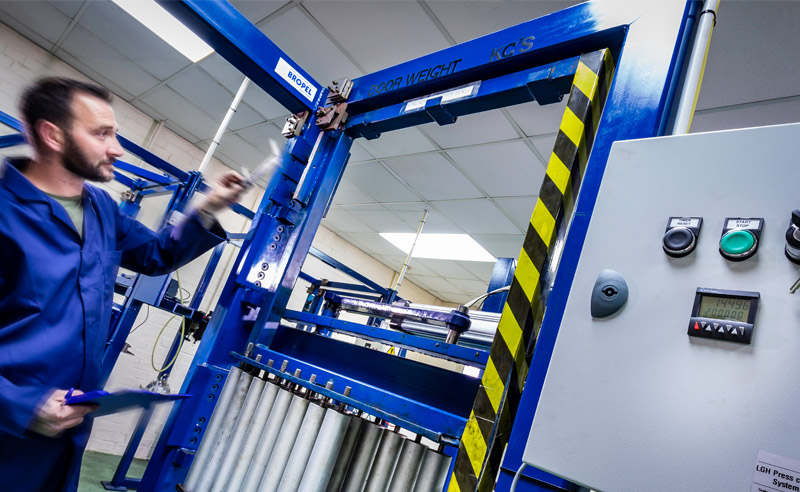
Digit 3: Test Door Mass
Eight different grades are indicated by the third digit, indicating the weight of the doors that the hinges have been tested with and what weight of door they should be used on in situ, from 10-160g.
Grade 0: 10Kg Test Door mass
Grade 1: 20Kg Test Door mass
Grade 2: 40Kg Test Door mass
Grade 3: 60Kg Test Door mass
Grade 4: 80Kg Test Door mass
Grade 5: 100Kg Test Door mass
Grade 6: 120Kg Test Door mass
Grade 7: 160Kg Test Door mass
Digit 4: Suitability for use on fire/smoke doors
This digit is much more binary: a zero means it should not be used on smoke/fire door assemblies. A one means that the hinge can be used on smoke/fire doors, meaning it must meet the BS476 fire test standards and be CE-marked for compliance.
Digit 5: safety
Single-axis hinges are required to satisfy the essential requirement of ‘safety in use’, that it is fit for purpose. Again, this is a binary criteria: grade 1 means the hinge is safe to use.
Digit 6: Corrosion Resistance
The sixth digit indicates how well the hinge will resist corrosion in accordance with EN 1670. Hinges are graded from zero, where the hinge has no particular corrosion resistance, up to grade four, which has the highest level of corrosion resistance for hinges that might be used in the most harsh environments like marine environments where there is high exposure to salt, or industrial areas where there may be exposure to corrosive chemicals for example.
There are five grades of corrosion resistance:
Grade 0: No defined corrosion resistance
Grade 1: Mild resistance
Grade 2: Moderate resistance
Grade 3: High resistance
Grade 4: Very high resistance
Digit 7: Security
Annex C of BS EN 1935:2002 gives details on the grade of hinge to use for the security required:
Grade 0: No security
Grade 1: suitable for applications that need a degree of security.
Digit 8: Hinge Grade
This ranges from Grade 1 to Grade 14 with the number indicating the hinge’s overall performance based on a combination of factors, including durability, strength, and suitability for different applications.
| Hinge Grade | Usage | Test Cycles | Door Mass |
|---|---|---|---|
| 1 | Window | 10,000 | 10 kg |
| 2 | Window | 10,000 | 20 kg |
| 3 | Window / Door | 25,000 | 20 kg |
| 4 | Door | 200,000 | 20 kg |
| 5 | Window | 10,000 | 40 kg |
| 6 | Window / Door | 25,000 | 40 kg |
| 7 | Door | 200,000 | 40 kg |
| 8 | Window | 10,000 | 60 kg |
| 9 | Window / Door | 25,000 | 60 kg |
| 10 | Door | 200,000 | 60 kg |
| 11 | Door | 200,000 | 80 kg |
| 12 | Door | 200,000 | 100 kg |
| 13 | Door | 200,000 | 120 kg |
| 14 | Door | 200,000 | 160 kg |
But apart from that 8-digit code, the hinge should display other information, all designed to let you know that the hinge is the right one for the job.
CE (and maybe UKCA) markings
The CE mark demonstrates that the product has been tested successfully by an accredited third-party test house and that the factory producing the hinge has passed stringent control audits carried out by a UKAS-notified certification body. This is particularly important for fire doors as, since 2016, under the Construction Products Regulations, all hardware that is covered under the scope of a harmonised European standard – like hinges – must be CE marked if it is to be used on a fire door.
In 2024, the UK government extended the recognition of the CE marking for construction products, including door hardware, beyond the previous June 2025 deadline. So, while door hardware in UK Britain can continue using either the CE or UKCA marking, products intended for the EU markets must carry a CE mark where applicable.
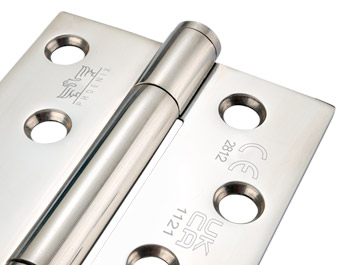
Manufacturer’s Name or Trademark
Or other means of identification. This is useful for identifying the manufacturers for warranty tracking and quality control. This is especially important if, for example, a fire door needs remediating. Hardware must be replaced with the exact same hinges it was tested with to maintain its fire safety integrity.
European standard
The number of the European standards that the hinge has been tested to must also be clearly visible.
All of this information must still be visible when the hinge is installed, so it is usually engraved on the outer face of the hinge.
Choosing the Right Hinge
If you need guidance on the right hinge to choose, why not get in touch with the hinge experts at Cooke Brothers. They will be happy to talk you through your project and the hinge options available from the UK’s leading manufacturer.


