
Made To Measure Push and Kick Plates Specification
November 2026
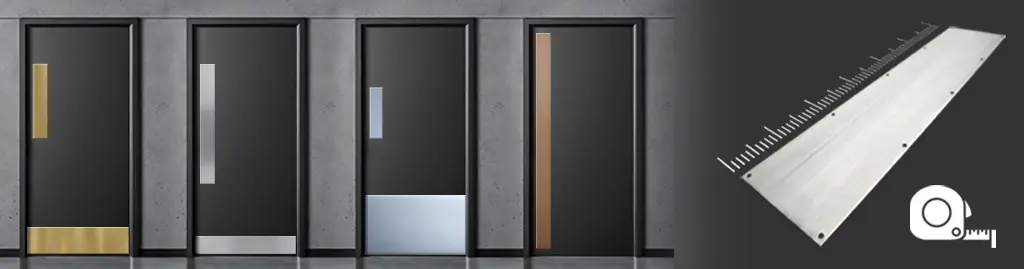
Walk through almost any commercial building, and you’ll find push and kick plates doing exactly what they were designed to do. They protect doors from everyday wear, extend the life of the doorset and help maintain a smart appearance in busy environments.
For many projects, standard sizes are perfectly adequate. A straightforward office fit-out or education project may only require off-the-shelf plates in a standard material and finish.
But not every project is that straightforward.
Refurbishment schemes often involve non-standard door sizes. Architects may want hardware that complements a carefully developed interior design. Healthcare environments might require larger trolley plates, while specialist commercial projects may call for custom finishes, engraved signage or plates manufactured to an unusual shape.
When that happens, specifying the nearest standard product can mean compromise. Working directly with a manufacturer offers another option. Cooke Brothers’ online Custom Push and Kick Plate Configurator has been developed to make specifying bespoke door plates as straightforward as ordering a standard product. Behind the configurator sits more than 150 years of manufacturing experience, allowing architects, door manufacturers, joiners and architectural ironmongers to specify plates manufactured to their exact requirements rather than adapting stock products to fit.
Why choose bespoke push and kick plates?
There is a common misconception that bespoke manufacture is only appropriate for prestigious or complex architectural projects. In reality, many bespoke plates are specified simply because they make practical sense.
A door may need a plate that falls somewhere between two standard sizes, a refurb project may need replacement plates that align with existing fixing holes. Alternatively, an interior designer may want the visible ironmongery to match throughout the building, or a contractor may need plates supplied without fixing holes because the installation method has already been determined. None of these requirements is particularly unusual.
Producing the plate to suit the project is often simpler than modifying a standard product once it arrives on site. It also helps achieve a neater finish and reduces unnecessary installation work. For architects, designers and specifiers, bespoke manufacture offers greater flexibility without making the specification process more complicated.
Manufactured to your specification
The Cooke Brothers Push and Kick Plate configurator has been designed to take the complexity out of ordering bespoke push and kick plates. Rather than requesting drawings or exchanging multiple emails, you can build the specification online by selecting a series of straightforward options and receive an instant quotation. Behind that simple process is a manufacturing facility producing each plate to the specification provided.
Step 1: Select the material
The first stage is choosing the most appropriate material for the application in hand. Options include:
- 316 marine-grade stainless steel
- 304 grade stainless steel
- 430 stainless steel
- Solid brass
- Aluminium
Each material has different characteristics. The most common choice for internal commercial applications is 304 stainless steel because it provides a good balance of durability and corrosion resistance at a sensible price. Durable marine-grade 316 stainless steel is well-suited to coastal locations or environments exposed to aggressive cleaning regimes, while brass and aluminium offer alternative aesthetic and performance characteristics depending on the project. For internal, dry environments, 430 stainless steel can provide a cost-effective option for push and kick plates where higher levels of corrosion resistance are not required.
Selecting the right material at the outset ensures the finished plate is appropriate for both the environment and the expected level of use.
Step 2: Choose the material thickness
Not every door experiences the same level of traffic. A meeting room in a commercial office will generally require less protection than a hospital corridor, school entrance, or service door used throughout the day by people, trolleys, and equipment.
The Cooke Brothers Bespoke Push and Kick Plate Configurator allows customers to select the most appropriate material thickness for the application, from lighter-duty plates through to heavier-duty options for more demanding environments. Matching the thickness to the application avoids cost and ensures the plate performs as intended throughout its service life.
Step 3: Select the finish
Door hardware is increasingly viewed as part of the overall architectural design rather than simply a functional component. Alongside brushed and polished stainless steel, projects may call for finishes that complement surrounding ironmongery, joinery or interior schemes.
Selecting the finish at the specification stage allows push and kick plates to become part of a coordinated hardware package rather than an obvious addition once the building is complete.
Step 4: Choose the design
Although seemingly a small detail, the profile of the plate contributes to its overall appearance. The configurator allows customers to specify either square or radiused corners, making it easy to match the style of the surrounding architectural hardware or reflect the design language of the wider project.
Step 5: Specify the fixing method
Installation requirements vary from project to project. Some contractors prefer countersunk screw fixings for maximum security, while others require adhesive backing or plates supplied without fixing holes to give a clean aesthetic
Providing these options at the ordering stage removes unnecessary site modifications and helps ensure the finished plate arrives ready for installation.
Step 6: Enter the size and quantity
The final stage is simply entering the required dimensions and quantity. Rather than selecting the closest standard size, the plates are manufactured to the dimensions entered into the configurator. Once complete, the system generates an instant quotation before allowing the order to be placed online.
Step 7: Door Numbering
For projects involving multiple doors, Cooke Brothers can mark the back of each push or kick plate with its corresponding door number. This makes it easier to identify which plate belongs to which door, whether the plates are being fitted in the factory or installed on site.
Unlike decorative engraving, the numbering is applied to the reverse of the plate, so it remains hidden once installed. It’s a simple way to make installation more straightforward, particularly on larger projects where plate sizes and specifications may vary between doors.
For customers producing multiple doors or repeat projects, this provides a straightforward and consistent route to specifying bespoke products without adding unnecessary administration.
More than an online ordering tool
Although the configurator makes the process simple, it is only one part of the service.
Every order is manufactured by Cooke Brothers using the same production expertise that underpins the company’s wider architectural hardware range. Precision laser profiling, machining and finishing allow plates to be produced accurately and consistently, whether the requirement is a single bespoke plate or a larger production run.
That manufacturing capability is what distinguishes bespoke manufacture from simply ordering a product in a different size. It allows architects and specifiers to move beyond standard catalogue dimensions while retaining the quality, consistency and repeatability expected on commercial projects.
Manufacturing flexibility goes beyond size
For many projects, specifying a bespoke push or kick plate is simply a question of ordering a non-standard size. However, manufacturing in-house allows much greater flexibility than changing the dimensions alone.
Because Cooke Brothers manufactures rather than modifies its products, plates can be produced in a wide variety of materials, finishes and configurations to suit the requirements of individual projects. Whether the priority is achieving a particular appearance, incorporating branding or solving a practical installation challenge, bespoke manufacture gives architects and specifiers considerably more freedom than standard catalogue products.
Colour matching for a coordinated finish
Push and kick plates are often one of the most visible pieces of door hardware, particularly on large entrance doors and glazed commercial doors. If the rest of the ironmongery has been carefully specified in a particular finish, a standard satin stainless steel plate can sometimes look out of place.
Cooke Brothers offers a colour matching service that allows push and kick plates to be finished to virtually any RAL or Pantone reference. This makes it possible to match doorsets, pull handles, hinges, locks and surrounding architectural hardware, helping to create a consistent appearance throughout a project.
The service is equally useful on refurbishment and heritage projects. Existing hardware may have finishes that are no longer available as standard or have developed a distinctive patina over many years. Working from either a colour reference or an existing sample, Cooke Brothers can produce finishes that complement the original ironmongery rather than standing out as an obvious replacement.
For design-led commercial projects, hotels, offices and high-end residential developments, colour matching provides another level of design flexibility without affecting product performance.
Laser etching and engraving
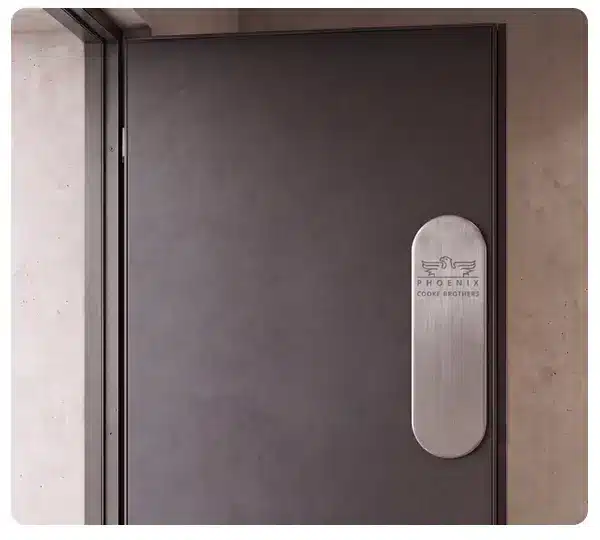
A push or kick plate can perform more than a protective function. Using precision laser engraving, plates can incorporate company logos, room numbers, accessibility symbols, directional information or other permanent markings as part of the manufacturing process. In many commercial buildings, this creates a cleaner appearance than applying separate signs or labels after installation. Hotels may incorporate room numbers into door furniture, offices can include company branding, while hospitals, schools and public buildings may use engraved symbols or identification to support wayfinding.
Because the engraving is incorporated during manufacture, it forms a permanent part of the finished plate rather than relying on applied graphics or adhesive labels that may deteriorate over time.
Bespoke shapes for specialist projects
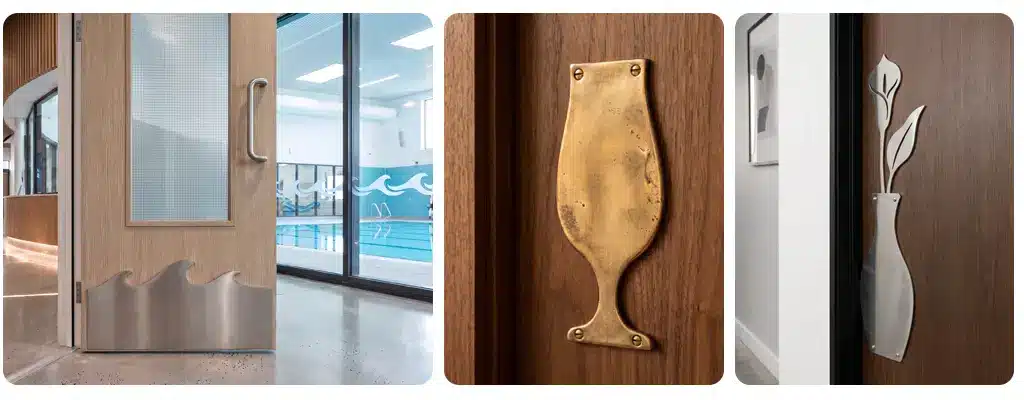
Although rectangular plates remain the most common specification, they are by no means the only option. Laser profiling allows plates to be manufactured in almost any practical shape, giving architects greater freedom where standard rectangular plates don’t suit the overall design.
For example, a coffee shop might choose a push plate shaped like a coffee cup, while a brewery visitor centre could incorporate a barrel profile. Children’s healthcare environments, museums and visitor attractions often look for opportunities to introduce subtle design features that reflect the character of the building without compromising durability.
Equally, bespoke manufacture can simply be about producing a plate that follows an unusual door profile or accommodates adjacent hardware. It doesn’t always have to be decorative; sometimes it is simply the most practical solution.
Part of a wider bespoke manufacturing capability
The custom push and kick plate configurator reflects the wider approach Cooke Brothers takes to manufacturing. Rather than asking customers to adapt standard products, the emphasis is on manufacturing components that suit the requirements of the project.
The same thinking can be seen elsewhere across the range. Cooke Brothers’ Continuous Hinge Cut-to-Length Service, for example, enables continuous hinges to be manufactured to the exact length required, reducing preparation work on site and helping installers achieve a more accurate finish.
Whether the requirement is a bespoke hinge, a colour-matched push plate or an engraved door plate, the principle remains the same: manufacture the product to suit the specification, rather than expecting the specification to suit the product.
A practical approach to bespoke manufacture
Bespoke manufacture doesn’t have to mean a complicated ordering process.
The Cooke Brothers configurator has been designed to make specifying custom push and kick plates as straightforward as ordering a standard product, while giving architects, joiners and door manufacturers access to considerably greater manufacturing flexibility.
From a simple change in dimensions through to specialist finishes, engraved plates or completely bespoke shapes, the process remains straightforward, and the result is a product manufactured specifically for the project.
Need advice on a bespoke requirement?
If you’re specifying push and kick plates for a commercial, education, healthcare or specialist project and need something beyond a standard product, the Cooke Brothers technical team can help.
Whether you require non-standard dimensions, colour matching, laser engraving or a completely bespoke design, get in touch for practical technical advice and guidance on the most appropriate solution.
FAQs
What are custom push and kick plates?
Custom push and kick plates are manufactured to specific dimensions, materials, finishes and fixing requirements rather than supplied in standard sizes.
Can push and kick plates be colour matched?
Yes. Cooke Brothers can colour match plates to RAL and Pantone references, helping coordinate door hardware with wider architectural finishes.
Can door plates be engraved?
Yes. Logos, room numbers, accessibility symbols, directional information and other permanent markings can be laser engraved during manufacture.
Can push and kick plates be manufactured in bespoke shapes?
Yes. Laser profiling allows plates to be produced in non-standard shapes as well as bespoke sizes, making them suitable for branded, themed or architect-designed projects.


