
The Complete Guide to Push and Kick Plates
November 2026
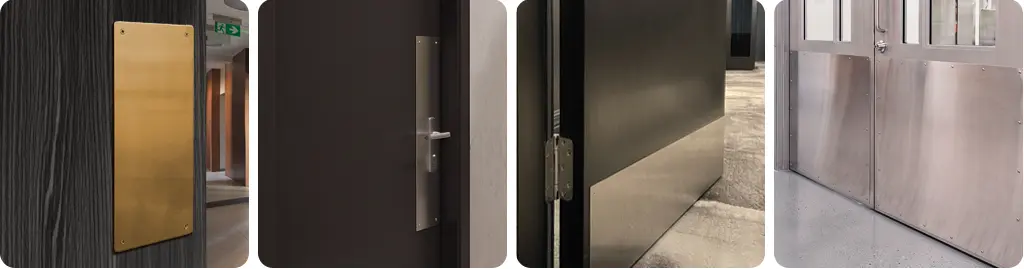
Push and kick plates rarely attract much attention during the design stage. Whether they are specified as door kick plates, door push plates, or door finger plates, they are relatively inexpensive, uncomplicated to specify, and often viewed as a finishing detail rather than a critical piece of architectural hardware.
In schools, hospitals, offices, transport hubs and commercial buildings, doors are subjected to thousands of daily impacts from people, trolleys, wheelchairs, cleaning equipment and deliveries. Without suitable door protection plates, door faces quickly become scratched, dented and worn, creating unnecessary maintenance costs and shortening the life of the doors themselves.
A well-specified door kick plate or push plate protects one of the most heavily used parts of the door while contributing to a clean, coordinated appearance. The challenge lies in selecting the right material, finish, dimensions and fixing method for the environment in which it will be used.
This guide explains the different types of push and kick plates, where they are typically used and the specification considerations that help ensure they continue performing for years rather than months.
What are push and kick plates?
Push and kick plates are door protection plates fixed to the face of a door to reduce wear and damage in areas subject to regular contact. Depending on their position and purpose, they may be specified as door kick plates, door push plates, door finger plates or trolley plates.
Although they are often grouped together, each performs a slightly different role.
| Plate Type | Typical Position | Primary Purpose |
| Push plate | Hand height | Protects the door from repeated hand contact |
| Finger plate | Behind a pull handle | Prevents finger marks and localised wear |
| Kick plate | Bottom of the door | Protects against footwear, trolleys and equipment |
| Trolley plate | Lower or mid-height | Protects against repeated impact from wheeled traffic |
Push plates
Door push plates are fitted at hand height on the pull or push face of a door. Rather than placing their hands directly on the door surface, people push against the plate instead. This protects decorative finishes from fingerprints, scratches and wear while providing a durable contact surface in busy public buildings.
Push plates are particularly common on:
- schools and universities
- hospitals and healthcare facilities
- offices
- commercial buildings
- apartment developments
- retail environments
They are frequently specified alongside pull handles on manually operated doors and form part of many commercial door hardware schedules.
Kick plates
Door kick plates are installed at the bottom leading edge of the door where damage is most likely to occur from footwear, trolleys, wheelchairs, cleaning machines or delivery equipment. Their primary purpose is protection rather than reinforcement. Replacing a damaged door kick plate is significantly quicker and more economical than repairing or replacing the door itself.
In buildings with heavy pedestrian traffic, correctly specified door kick plates can considerably extend the appearance and service life of timber, laminate and veneered doors.
Finger plates
Door finger plates perform a similar function to push plates but are generally narrower and mounted vertically behind a pull handle.
They prevent fingermarks and localised wear in the area immediately surrounding the handle and are commonly specified on office doors, apartment entrances, prestige commercial developments and other buildings where appearance is important.
Trolley plates
Trolley plates provide additional door protection for doors that are regularly struck by wheeled equipment rather than pedestrian traffic alone. They are commonly specified in hospitals, care homes, hotels, warehouses, commercial kitchens and service areas where catering trolleys, linen carts, roll cages, pallet trucks or housekeeping equipment frequently pass through doorways.
Unlike a standard kick plate, a trolley plate is typically larger and positioned higher on the door to correspond with the height at which equipment is most likely to make contact. The size and position should always reflect the type of trolley or equipment being used rather than relying on a standard dimension.
In busy operating environments, correctly specified trolley plates can help to significantly reduce damage to door faces, extending the service life of the door, maintaining a smarter appearance and reducing ongoing maintenance costs.
Where are Door Kick Plates and Push Plates Used?

Almost any frequently used door can benefit from some form of protection, although the specification will vary according to its environment.
- Healthcare facilities often prioritise hygiene, durability and ease of cleaning.
- Schools require door kick plates and door push plates capable of withstanding constant daily use and occasional abuse.
- Hotels and prestige commercial buildings may place greater emphasis on aesthetics, matching finishes with surrounding architectural ironmongery.
- Industrial environments frequently require heavier gauge door protection plates capable of resisting impact from equipment and goods movement.
- External doors present another challenge. Exposure to rain, salt air and atmospheric pollution can influence both material choice and surface finish, particularly in coastal locations.
Understanding how the building will actually be used is often more important than simply selecting the thickest plate available.
Choosing the Right Material for Door Kick Plates
Material selection influences durability, appearance, corrosion resistance, maintenance requirements and cost. Selecting the appropriate material at the specification stage helps ensure push and kick plates continue performing throughout the life of the door.
| Material | Typical Applications | Key Benefits |
| 304 stainless steel | Offices, schools, healthcare, commercial buildings | Durable, corrosion resistant and easy to maintain |
| 316 marine-grade stainless steel | Coastal projects, swimming pools, harsh environments | Superior corrosion resistance |
| 430 stainless steel | Internal, dry environments | A cost-effective option where corrosion resistance is not required |
| Aluminium | Commercial interiors, large plates | Lightweight, corrosion resistant and economical |
304 stainless steel
Grade 304 stainless steel remains the most widely specified material for stainless steel kick plates, finger plates and push plates used in internal commercial applications.
It offers a corrosion-resistant, easy-to-maintain solution with an attractive architectural finish suitable for most educational, healthcare and office projects. For many specifications, it represents the best balance between performance, appearance and value.
316 marine-grade stainless steel
Where door kick plates are exposed to coastal conditions, swimming pools, chemical environments or aggressive cleaning regimes, 316 stainless steel offers increased corrosion resistance.
Although more expensive than 304 grade, it can provide a significantly longer service life in demanding environments, reducing future maintenance and replacement costs.
Aluminium
Aluminium provides a lightweight alternative where weight reduction or cost is a consideration. It offers good corrosion resistance and can be supplied in a variety of finishes, making it suitable for many commercial applications.
It is often chosen where larger door protection plates are required, helping to reduce weight without compromising durability.
Specifying Push and Kick Plates

Selecting the correct material is only one part of the specification. Several other factors influence both performance and appearance.
Thickness
Lighter gauges are suitable for moderate traffic areas where protection is primarily cosmetic.
In busier environments, it often makes sense to specify a thicker kick plate that is better able to cope with everyday knocks and impacts. The right choice depends less on where the door is located and more on how heavily it will be used.
Size
Standard sizes suit many applications, but there are plenty of projects where a bespoke solution is more appropriate. Kick plates are commonly specified to cover the area most vulnerable to damage, while push plates should comfortably accommodate natural hand placement.
Larger commercial entrances or doors subjected to frequent wheeled traffic may require oversized or full-height door protection plates to cope with intensive use.
Increasingly, architects and contractors are specifying made-to-measure kick plates, cut-to-size kick plates, and bespoke push plates for doors to suit non-standard openings, refurbishment projects, and architect-designed buildings where standard catalogue sizes are not appropriate.
Corners and Edges
Square corners suit many contemporary buildings and provide a clean, straightforward finish. Radiused corners are often preferred on more traditional projects or where they match other architectural details. In most cases, the choice comes down to appearance rather than performance.
Finish
Brushed satin stainless steel is the finish most commonly specified for commercial buildings. It is hard-wearing, easy to maintain and less likely to show everyday marks and scratches. Polished finishes offer a brighter, more reflective appearance, but they generally need more regular cleaning to keep them looking their best.
Where architectural ironmongery has been colour matched using plated finishes, powder coating or specialist finishes, Cooke Brothers can manufacture door kick plates, push plates and finger plates to complement the wider ironmongery schedule, creating a consistent appearance throughout the project.
Fixing Methods
The method of fixing the plate to the door needs to reflect both the practical requirements and the aesthetic expectations of the project. Countersunk screw fixing remains the most secure and popular option for door kick plates installed in high-traffic environments and allows straightforward replacement if required.
Adhesive fixing, with no visible fixings, creates a cleaner appearance and can simplify installation where drilling is not practical.
Some projects require plates supplied without holes to allow fixing methods to be determined during installation. The most appropriate solution will often depend on the door construction, substrate and anticipated level of use.
Specification Considerations Beyond the Plate Itself
Although there is no dedicated British Standard governing push and kick plates, they should always be specified within the wider context of the complete door assembly.
Accessibility requirements under Approved Document M and BS 8300 should be considered where door push plates and finger plates form part of the user interface of accessible doors.
Where fitted to fire-resisting doors, any additional hardware should be compatible with the tested doorset specification and should never compromise fire performance or certification.
For external applications, corrosion resistance becomes particularly important. Selecting the correct grade of stainless steel for stainless steel kick plates can improve long-term performance and reduce maintenance.
It’s also worth considering how the door will be cleaned. In hospitals, laboratories and food production facilities, hardware may be exposed to frequent cleaning using strong chemicals, so the chosen finish needs to be able to withstand those conditions over the long term.
When Standard Size Kick Plates Aren’t Enough
Many projects require something beyond an off-the-shelf solution. Architectural designs may incorporate unusually wide doors, curved details, specialist access control equipment or branding requirements that call for bespoke manufacture rather than a standard catalogue product.
Laser cutting allows door kick plates, push plates and finger plates to be produced with precise apertures for readers, vision panels, signage and other hardware while maintaining clean, consistent detailing.
Bespoke manufacture also enables made-to-measure kick plates, kick plates cut to size, oversized door protection plates, engraved logos, decorative detailing and large-format architectural plates to be produced with the same level of accuracy as standard products.
Rather than compromising with the closest standard size, specifiers can order plates that match the door, the hardware and the design intent from the start.
Common Specification Mistakes Push and Kick Plates
Problems usually arise when the specification doesn’t reflect how the door will actually be used. A 304 stainless steel kick plate may be perfectly suitable for an internal office, but a different grade would be a better choice for an exposed coastal location. Equally, a polished finish that looks excellent on day one may not stay that way on a busy school entrance, and adhesive fixing isn’t always the best option where doors are regularly struck by trolleys or other equipment.
Another common mistake is specifying plates that are simply too small, leaving the areas most vulnerable to damage exposed. Taking a few moments to understand how the building will actually function usually results in a specification that performs better throughout the life of the building.
Why Manufacturing Capability Matters
There is nothing complicated about a push or kick plate, but quality becomes obvious at installation. Accurate dimensions, clean edges and a consistent finish all make the difference between a plate that fits first time and one that requires adjustment on site.
The ability to manufacture made-to-measure kick plates, bespoke push plates for doors, custom finger plates and specialist door protection plates can prove invaluable on refurbishment projects and architect-designed buildings where standard dimensions are simply not appropriate.
Cooke Brothers also offers a Custom Push and Kick Plate Configurator, allowing architects, door manufacturers, joiners and architectural ironmongers to specify bespoke plates online by selecting the material, thickness, finish, corner style, fixing method, dimensions and quantity required. The result is a straightforward route to specifying products manufactured to suit the project, rather than adapting standard products on site.
Beyond standard rectangular plates, in-house manufacturing also allows:
- Colour matching to RAL and Pantone references to complement wider architectural ironmongery schedules.
- Precision laser engraving for company logos, room numbers, accessibility symbols and wayfinding.
- Bespoke shapes for themed environments, visitor attractions, healthcare projects and architect-designed buildings.
- Plates manufactured to suit unusual door sizes, specialist hardware and refurbishment projects.
For specifiers, working with a manufacturer that understands both the technical and practical aspects of architectural door hardware often makes the specification process considerably easier.
Get Technical Advice Before You Specify Push and Kick Plates
Choosing the right door kick plates, push plates or finger plates is about more than selecting a piece of sheet metal. Material grade, finish, thickness, fixing method and manufacturing quality all influence long-term performance, maintenance requirements and appearance.
Whether you require standard products, made-to-measure kick plates, kick plates cut to size, bespoke push plates for doors or specialist finishes, taking these factors into account early in the specification process helps ensure the completed doors continue to perform throughout their service life.
If you are specifying architectural door hardware for a commercial, healthcare, education or specialist project, the Cooke Brothers technical team can provide practical guidance on material selection, bespoke manufacture and the most appropriate solution for your application.
FAQs
What is a door kick plate?
A door kick plate is a protective metal plate fixed to the bottom of a door to reduce damage caused by footwear, trolleys, wheelchairs, cleaning equipment and everyday traffic. Replacing a damaged kick plate is usually quicker and more economical than repairing or replacing the door itself.
What is a door finger plate?
A door finger plate is a narrow protective plate fitted vertically behind a pull handle. It prevents finger marks, scratches and localised wear in the area that receives the most frequent hand contact.
Where do finger plates go on a door?
Finger plates are normally installed behind a pull handle at hand height. Their position protects the door surface immediately surrounding the handle while maintaining the appearance of the door.
What is the best material for a door kick plate?
For most internal commercial applications, 304 stainless steel offers an excellent balance of durability, corrosion resistance and appearance. Where door kick plates are exposed to coastal conditions, aggressive cleaning regimes or chemical environments, 316 marine-grade stainless steel is generally the preferred option.
Can push and kick plates be fitted to fire doors?
Yes. Push plates and door kick plates can be fitted to fire-resisting doors provided they are compatible with the tested doorset specification and do not compromise the fire performance or certification of the complete door assembly.
Can you buy made-to-measure kick plates?
Yes. Cooke Brothers manufactures made-to-measure kick plates, cut-to-size kick plates, and bespoke push plates for doors in a wide range of sizes, materials, finishes, and configurations. Plates can also be supplied with specialist cut-outs, laser engraving, colour-matched finishes and non-standard shapes to suit individual project requirements.
Can door kick plates be colour matched?
Yes. Door kick plates can be colour matched to RAL and Pantone references, allowing them to complement surrounding architectural ironmongery, doorsets and interior design schemes. This is particularly useful on design-led commercial projects, heritage refurbishments and prestige developments.
Can door kick plates be engraved?
Yes. Precision laser engraving can incorporate company logos, room numbers, accessibility symbols, directional information and other permanent markings, allowing door protection plates to perform both a protective and wayfinding function.


