
Why Are Continuous Hinges Used in Anti-Barricade Door Systems?
July 2026
Why Are Continuous Hinges Used in Anti-Barricade Door Systems?
When people think about anti-barricade door systems, they tend to focus on the emergency release mechanism. And that’s understandable because the ability to gain access to a room during a barricade incident is the defining feature of the system and often the reason it has been specified in the first place.
What is discussed less often is the hinge. Yet in many anti-barricade systems, the hinge is one of the hardest-working components in the entire door set. It supports the door during normal day-to-day use, contributes to reduced-ligature performance and, in some designs, plays a critical role in the emergency release operation itself.
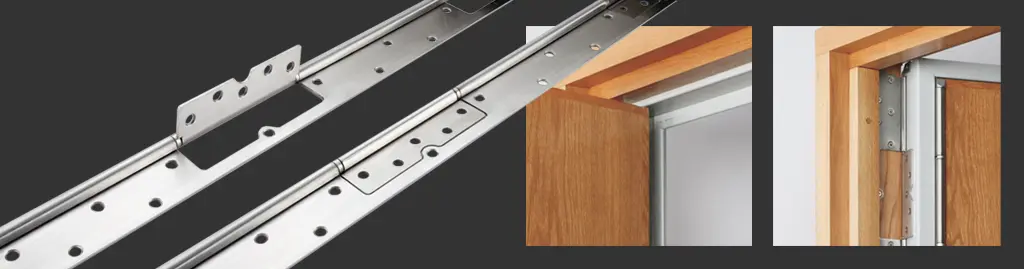
For this reason, anti-barricade systems rarely use standard hinge arrangements. Instead, they often rely on full-height continuous hinges, sometimes referred to as piano hinges. Cooke Brothers’ DUALWAY system uses the company’s own Interleaf Continuous Hinge, developed specifically for anti-barricade and reduced-ligature applications.
What Is a Continuous Hinge?
A continuous hinge is a hinge that runs for the full height of the door. Many people know them as piano hinges, a term that originated from their use on piano lids. In architectural ironmongery, however, the term “continuous hinge” is generally preferred because it covers a much wider range of specialist designs and applications.
Unlike traditional butt hinges, which support the door at two or three fixing points, a continuous hinge distributes load along the entire height of the door and frame, creating a more stable assembly and reducing the stress placed on individual fixings, frame sections and hinge positions. That difference becomes particularly important in environments where doors are subjected to sustained heavy use.
Our DUALWAY Anti-Barricade system uses our special Interleaf Continuous Hinges, developed by Cooke Brothers to provide full-height support while maintaining the minimal gaps and strength required for specialist healthcare door systems.
Why Standard Hinges Can Struggle in Behavioural Environments
The demands placed on doors in mental health and behavioural settings often differ significantly from those found in conventional commercial buildings. Doors may be subjected to repeated impact, aggressive operation, hanging loads and occasional physical abuse. In these environments, weaknesses tend to appear first around concentrated load points.
Traditional butt hinges place a significant proportion of the door’s weight onto a relatively small number of fixing positions. Over time, that can contribute to hinge wear, frame movement and alignment issues, particularly on heavily used doors.
This is not simply a maintenance issue in anti-barricade applications. Consistent door alignment and reliable operation are fundamental to the performance of the wider door set. A release mechanism can only perform as intended if the door and frame assembly remain stable and properly aligned.
Why Continuous Hinges Are Used in Anti-Barricade Systems
One of the principal advantages of a continuous hinge is the way it distributes forces across the entire door set. Instead of concentrating weight at a handful of hinge positions, the load is spread evenly along the full height of the frame. This helps reduce localised stress, improve long-term durability and maintain alignment over years of service.
In practical terms, that means:
- reduced frame distortion
- improved resistance to heavy use
- better alignment retention
- lower stress on fixings
- improved operational consistency
For facilities managers responsible for healthcare and behavioural environments, those benefits often translate into fewer maintenance issues and greater confidence that the door set will continue to operate as intended. The Cooke Brothers Interleaf Continuous Hinge takes this principle a step further by supporting the entire door and frame assembly throughout the anti-barricade release process, rather than simply acting as the pivot point for the door.
Supporting Emergency Release Operation
In many anti-barricade systems, the hinge does more than simply support the door. Systems such as DUALWAY use a frame-within-frame arrangement that allows the complete door and inner frame assembly to move during emergency release operation. When the locking mechanism is released, the assembly swings outward away from the obstruction, allowing staff to gain immediate access to the room. That places significant demands on the hinge arrangement.
A full-height Interleaf Continuous Hinge provides support across the entire assembly, helping to maintain stability during both normal operation and emergency release situations. This is one reason why Interleaf Continuous Hinges have become a common feature of anti-barricade door systems used in mental healthcare and behavioural environments.
Reduced-Ligature Benefits of Continuous Hinges
Continuous hinges are also widely used because they support reduced-ligature design objectives. In behavioural and mental healthcare settings, reducing potential attachment points forms an important part of the wider risk-management strategy. Whilst no environment can be considered entirely ligature-proof, hardware can be designed to reduce opportunities wherever reasonably possible.
Compared with conventional butt hinges, continuous hinges can:
- minimise gaps around the hinge side of the door
- reduce exposed hinge geometry
- create a more controlled interface between door and frame
- limit potential attachment opportunities
For this reason, continuous hinges are often specified alongside other reduced-ligature hardware such as specialist handles, escutcheons and concealed closing devices.
Why DUALWAY Uses an Interleaf Continuous Hinge
At the heart of the DUALWAY system is Cooke Brothers’ Interleaf Continuous Hinge. Developed specifically for anti-barricade and reduced-ligature applications, it is engineered to support the full door and frame assembly during both normal operation and emergency release.
Because the hinge supports the full height of the door and frame assembly, loads are distributed evenly across the door set rather than being concentrated at individual hinge positions. The arrangement also helps maintain a minimal gap between the door and frame whilst providing the strength required for anti-barricade operation.
The system also avoids the need for double-action floor springs, which can introduce maintenance and operational challenges in healthcare environments.
Continuous Hinges Versus Piano Hinges: Is There a Difference?
In most cases, no. “Piano hinge” is simply the traditional term that many people still use to describe a hinge that runs the full height of a door, panel or lid. Both terms are widely understood and are often used interchangeably.
The Interleaf Continuous Hinge is one example of how the traditional piano hinge has evolved into a highly engineered architectural component designed for specialist applications such as anti-barricade doors, secure healthcare and reduced-ligature environments.
Choosing the Right Hinge for an Anti-Barricade Door System
Not all continuous hinges are created equal. When specifying an anti-barricade door system, considerations typically include:
- door weight
- anticipated usage levels
- reduced-ligature requirements
- maintenance considerations
- compatibility with closers
- emergency release operation
- overall door set design
For that reason, the hinge should never be viewed as an isolated component. Its performance is closely linked to the wider door set and the operational requirements of the facility.
The most successful anti-barricade installations tend to be those where the door, frame, hinges, locking arrangements and emergency release mechanisms have been designed to work together as a complete assembly.
Further Reading
This article forms part of Cooke Brothers’ series on doors and hardware for mental health, behavioural and secure care environments.
Related articles:
- Doors and Hardware in Mental Health, Secure and Behavioural Environments
- What Is an Anti-Barricade Door System?
- FAQs About Anti-Barricade Doors and Reduced-Ligature Hardware
FAQs
What is the difference between a piano hinge and a continuous hinge?
Nothing. Piano hinge is the traditional name for a hinge that runs the full height of a door, lid or panel. In architectural ironmongery, the term continuous hinge is more commonly used because it covers a wider range of specialist hinge designs and applications.
Why are continuous hinges used in anti-barricade doors?
Continuous hinges distribute load across the full height of the door and frame, improving durability, maintaining alignment and supporting the movement of the door assembly during emergency release operation.
Are continuous hinges better than butt hinges?
Neither is universally better. Butt hinges are suitable for many standard door applications, while continuous hinges are often preferred in high-use, high-abuse or specialist environments where additional strength, durability and load distribution are required.
Do anti-barricade doors need continuous hinges?
Not all anti-barricade systems use continuous hinges, but they are commonly specified because they provide greater strength, improved alignment and support reduced-ligature design objectives.
Why are continuous hinges used in mental health facilities?
Continuous hinges help reduce gaps around the hinge side of the door, improve resistance to abuse and support the long-term reliability of doors used in challenging environments.
Can continuous hinges help reduce maintenance?
Yes. By distributing load across the full height of the door and frame, continuous hinges can reduce stress on individual fixing points and help minimise wear, alignment issues and hinge-related maintenance problems.
Are continuous hinges suitable for retrofit projects?
Yes. Continuous hinges can often be incorporated into both new-build and refurbishment projects, although suitability depends on the existing door, frame and hardware arrangement.
What type of hinge is best for behavioural healthcare environments?
The most appropriate hinge depends on the operational requirements of the facility. Continuous hinges are often selected because they combine strength, durability, reduced-ligature benefits and compatibility with specialist door systems.
Can a continuous hinge support a heavier door?
Generally, yes. Because the load is distributed along the full height of the hinge, continuous hinges are often used on heavier or more demanding door applications where conventional hinges may experience higher levels of stress.
What hardware is typically used alongside continuous hinges in anti-barricade doors?
Continuous hinges are commonly used alongside reduced-ligature handles, concealed door closers, anti-tamper fixings, specialist locking systems and reinforced frame assemblies as part of a complete anti-barricade door set.
What is an Interleaf Continuous Hinge?
An Interleaf Continuous Hinge is Cooke Brothers’ specialist full-height hinge developed for demanding applications such as anti-barricade doors, reduced-ligature environments and secure healthcare facilities. Unlike conventional butt hinges, it supports the door and frame along their full height, improving durability, maintaining alignment and helping the doorset perform reliably during everyday use and emergency release situations.


