
What Is an Anti-Barricade Door System?
July 2026
What Is an Anti-Barricade Door System?
An anti-barricade system is designed to maintain emergency access to a room when an inward-opening door is obstructed from the inside.
In most day-to-day situations, the door behaves like a conventional door set. The difference only becomes apparent during an emergency, when staff may need to gain rapid access despite the door being blocked by furniture, body weight or an improvised barricade.
These systems are most often found in mental healthcare and behavioural settings, but their use has expanded considerably in recent years. Anti-barricade doors are now specified across a broad range of settings where safeguarding, behavioural risk or vulnerable occupants influence how spaces are designed and operated.
At Cooke Brothers, we’ve combined decades of expertise in architectural hardware with specialist engineering to develop DUALWAY, an anti-barricade system designed for the realities of today’s healthcare and behavioural environments.
That includes:
- Acute mental health wards
- CAMHS facilities
- SEND schools
- Behavioural support environments
- Secure healthcare settings
- Specialist residential care
- De-escalation rooms
- Custodial healthcare environments
As awareness around ligature reduction and emergency intervention has increased, anti-barricade door systems have become a much more important part of wider healthcare and safeguarding strategies.
What Does “Anti-Barricade” Actually Mean?
The term describes a door set arrangement that allows staff to release or open the door away from an obstruction during an emergency. In a conventional inward-opening room, a door can become extremely difficult to open if something heavy has been placed against it from the inside. In behavioural or mental healthcare environments, that obstruction may be deliberate.
An anti-barricade door system is designed specifically to overcome that problem. Different systems achieve this in different ways, but the objective is broadly the same: maintaining rapid staff access without compromising normal day-to-day operation, security or user privacy.
Most systems are designed so that the anti-barricade function activates only when needed in an emergency. In normal everyday use, the door continues to function in a familiar, controlled manner for both occupants and staff.
The DUALWAY Anti-Barricade Door System provides unrestricted, immediate access to a room when a patient has barricaded themselves in.
Why Barricading Presents a Serious Risk
Barricading is not simply a security issue. In many behavioural and secure healthcare environments, it becomes a real safeguarding concern. If a patient, resident or occupant becomes distressed, attempts self-harm or experiences a medical emergency behind a blocked inward-opening door, delayed access can quickly escalate the situation.
Forced entry through a barricaded conventional door set can compromise safeguarding procedures also create additional risks for staff. Delayed intervention can be dangerous, and occupants can be injured or unduly distressed during forced access.
The issue becomes particularly important in environments where staff are responsible for vulnerable people who may be at risk of self-harm, experiencing a behavioural crisis, or prone to aggressive behaviour. Occupants may also be vulnerable due to age or cognitive impairment. This is why emergency access has become a major consideration in modern mental healthcare and behavioural facility design.
How Anti-Barricade Door Systems Work
There is no single universal anti-barricade mechanism. Systems vary depending on the application, the level of security, and the facility’s operational requirements.
One of the most widely used approaches is the frame-within-frame arrangement employed by the DUALWAY anti-barricade door system from Cooke Brothers.
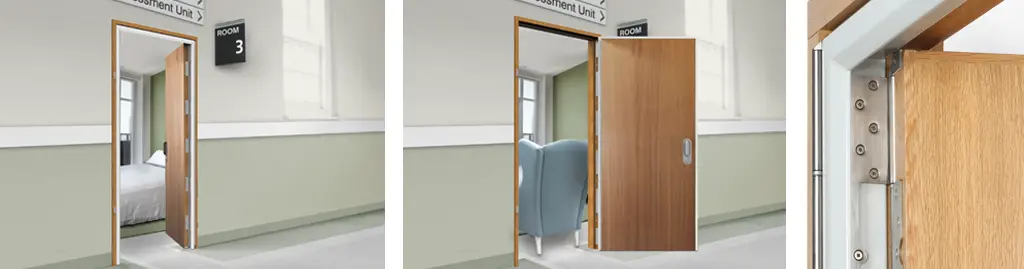
Under normal operation, the inward-opening door functions conventionally. In an emergency, staff can release the locking mechanism, allowing the complete inner frame and door assembly to swing outward away from the obstruction inside. This provides immediate access to the room without forcing the door open against the barricade.
The system relies on several integrated components working together:
- continuous hinge systems
- reinforced inner frames
- emergency release mechanisms
- hook bolt locking
- reduced-ligature hardware
- compatible closing devices
What matters operationally is not simply whether the door can release, but whether the system remains reliable after years of sustained use in demanding environments.
How Does DUALWAY Work?
In everyday use, the standard inward-opening door operates as normal, providing 105° to 115° of access using a purpose-designed full-height, reduced-ligature continuous hinge. The inner preformed DUALWAY steel frame provides rigid support and security through heavy-duty, purpose-designed mechanical hook bolt locking, with an electrically operated option also available.
In an emergency or when the door is barricaded, the door and DUALWAY inner frame can be quickly released, allowing the complete door set to swing outwards for immediate access to the room. Access is achieved by releasing the dual hook locks mortised into the outer frame, operated by unique security profile keys or an electrically operated release mechanism.
Typical Applications for Anti-Barricade Doors
Anti-barricade doors are most commonly associated with inpatient mental healthcare, but their use now extends into a much wider range of environments. In specialist education settings – particularly SEND schools and behavioural support units – safeguarding considerations increasingly influence door and hardware specification. Similar considerations apply within some residential care environments and specialist accommodation settings.
Healthcare projects remain the largest application area, particularly psychiatric intensive care units, acute mental health wards, CAMHS environments and secure healthcare units. This now extends to assessment suites and seclusion and de-escalation spaces.
The level of anti-barricade functionality that different facilities can vary. Some projects may prioritise rapid intervention capability above all else, while others focus more heavily on balancing safety measures with a less institutional environment.
Why Emergency Access Matters
Emergency access is often discussed in technical terms, but operationally it comes down to something fairly simple: how quickly staff can safely reach someone during a crisis like a self-harm incident, a medical emergency, incidents of aggressive behaviour or the need for an urgent safeguarding intervention.
With conventional inward-opening doors, forced access can become slow and physically difficult once a barricade is involved. Even where entry is eventually achieved, the process itself may increase distress or create additional safety risks for staff and occupants alike.
Anti-barricade systems are intended to reduce that delay and allow more controlled, calmer intervention procedures.
For estates and facilities teams, reliability is critical. The release mechanism has to operate consistently under pressure, often after years of heavy use and repeated abuse.
Reduced-Ligature Considerations
Most anti-barricade door systems are closely linked with reduced-ligature design principles. Again, the objective is not to describe any environment as completely “ligature proof”. The aim is to reduce opportunities for attachment and self-harm wherever reasonably possible through careful detailing and hardware selection. That influences hardware design and selection, frame details, and gap tolerances.
This is why continuous hinges are widely used in these environments: they help minimise gaps around the hinge side of the door and improve the door’s robustness by distributing the load more evenly across the frame and improving long-term alignment.
Common Hardware Features of Anti-Barricade Door Systems
Although specifications vary between projects, anti-barricade door sets commonly incorporate:
- continuous hinges
- reinforced steel frames
- emergency release mechanisms
- reduced-ligature hardware
- concealed or protected closers
- anti-tamper fixings
- heavy-duty locking systems
- flush or reduced-projection hardware arrangements
Choosing the Right Anti-Barricade Door System
The right system depends heavily on the building’s operational requirements. Factors that typically influence specification include not only the building, but the requirements of the people using it and the safeguarding procedures that are in place.
Early involvement from manufacturers, contractors and architectural ironmongers can help resolve compatibility and operational issues before installation begins.
Cooke Brothers manufactures the DUALWAY anti-barricade door system, alongside specialist continuous hinges and reduced-ligature hardware, at its UK production facility.
The DUALWAY system incorporates a number of important features that make it the perfect choice for the most demanding environments. It is manufactured at Cooke Brothers UK facility and is a purpose-made door solution designed specifically to address the needs of today’s challenging mental health and custodial environments, where there is a risk of ligature or self-harm.
DUALWAY’s unique two-way system provides a secure and safe solution for many sensitive healthcare applications. Featuring reduced ligature hinges and hardware, DUALWAY’s robust, rebated inner frame is engineered in preformed steel section. An electronic inner frame locking option is available.
Further Reading
This article forms part of Cooke Brothers’ series on doors and hardware for mental health, SEND and secure care environments.
Related articles include:
- Doors and Hardware in Mental Health, Secure and Behavioural Environments
- FAQs About Anti-Barricade Doors and Reduced-Ligature Hardware
- Why Continuous Hinges Are Used in Secure Healthcare Environments

You can download the latest DUALWAY brochure to read more about this innovative door system.
FAQs on Anti-Barricade Door Systems
What is an anti-barricade door system?
An anti-barricade door system allows staff to gain emergency access into a room even if the inward-opening door has been obstructed or barricaded from the inside.
Where are anti-barricade doors commonly used?
They are commonly used in mental health facilities, behavioural support units, CAMHS environments, SEND schools and secure healthcare settings.
Are anti-barricade doors fire-rated?
Some systems may be incorporated into fire-rated door sets, but fire performance depends on the complete tested assembly and project specification.
What is reduced-ligature hardware?
Reduced-ligature hardware is designed to minimise potential attachment points that could present self-harm risks.
Why are continuous hinges used in anti-barricade systems?
Continuous hinges improve durability, distribute load more evenly and help minimise gaps around the hinge side of the door.
Can anti-barricade door systems be retrofitted?
Yes. Many systems are specifically designed for retrofit installation within existing healthcare, education and local authority buildings.


