
Doors and Hardware in Mental Health, Secure and Behavioural Environments
July 2026
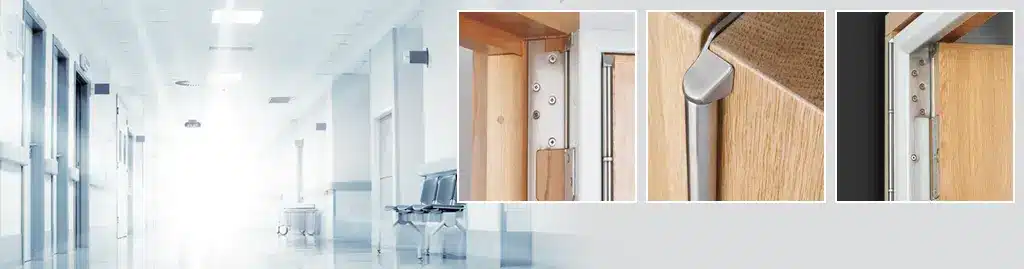
Doors and hardware in mental health, secure and behavioural environments are expected to do far more than control movement between rooms. They form part of the building’s wider safeguarding strategy. In some cases, they may need to support rapid emergency intervention. In others, the priority may be reducing opportunities for self-harm whilst still maintaining privacy, dignity, and a non-institutional feel for the people using the space day to day.
That creates a fairly demanding brief for architects, estates teams and specifiers. Hardware has to withstand heavy use and physical abuse, remain intuitive for staff under pressure and tolerate the realities of long-term healthcare operation. At the same time, there is increasing recognition that these environments should not feel overtly punitive or custodial unless absolutely necessary.
Over recent years, mental healthcare design has moved steadily towards calmer, more therapeutic, less institutional environments. There is now greater emphasis than ever on balancing safety and security with normality, reducing environmental stressors wherever possible. Doors and hardware play a pivotal role in that balancing act.
What Counts as a High-Risk or Behavioural Environment?
The term covers a broad range of facilities where behavioural risk, safeguarding, or vulnerability of the occupants and staff influences how buildings are designed and operated. Typical examples include:
- Acute mental health wards
- CAMHS facilities
- Behavioural support environments
- SEND schools
- Secure healthcare units
- Specialist residential care
- De-escalation rooms
- Custodial healthcare environments
The operational pressures may differ between settings, but the hardware challenges are often surprisingly similar. Doors may be exposed to repeated slamming, impact loading, tampering or attempted barricading. Ligature reduction becomes a key part of specification discussions, particularly around hinges, handles, closers and frame geometry. Maintenance teams also need systems that remain reliable under sustained heavy use without generating constant reactive call-outs.
Importantly, most of these environments are occupied continuously. Hardware failures rarely happen at convenient times, and replacing damaged components in secure or behavioural settings is rarely a straightforward operation. That tends to change how products are evaluated. Lifecycle performance and resilience often become just as important as initial specification cost.
Guidance for Doors and Hardware in Mental Health, Secure and Behavioural Environments
Requirements and guidance for doors in these sensitive settings prioritise safety and security by eliminating potential anchor points for self-harm and including anti-barricade features. The doors must be flush-fitting, tamper-resistant, and durable, incorporating features that prevent the attachment of cords or sheets.
Key regulations and design standards
- DHF TS 001:2013: this guidance for anti-ligature hardware, involves rounded, sloped surfaces, robust material strength, and tamper-resistant fasteners that require specific tools for maintenance.
- Material & Design: Doors and hardware must be flush with the door surface, using continuous hinges that help minimise gaps
- Load Testing: Anti-ligature hardware must be tested to withstand specific loads to ensure it does not easily break or allow for attachment, using tools like flat-blade screwdrivers and allen keys to verify security.
Key hardware for compliant door sets
- Hinges & Hardware: full-length continuous hinges instead of standard butt hinges to manage gaps better.
- Handles & Locks: door handles and knobs are designed to be conical, chamfered, or to eliminate anchor points.
- Push and kick plates must be recessed into the door to reduce ligature points
- Door Closers: concealed or specifically designed anti-ligature closers are used rather than surface-mounted ones.
- Vision Panels & Glazing: are often designed to be flush and secure, preventing tampering, removal, or breakage.
Regulatory and Specification Drivers
Specification decisions in mental health, behavioural and secure healthcare environments are rarely driven by a single regulation or product standard. In practice, they tend to be shaped by a combination of risk assessment, safeguarding requirements, NHS guidance, operational procedures and the practical realities of managing vulnerable occupants safely.
Estates teams and specifiers are increasingly expected to demonstrate that environmental risks have been carefully considered, particularly regarding ligature reduction, emergency access, and staff intervention. That has encouraged a broader shift towards complete door set thinking, where hinges, locks, closers, frames and hardware are assessed as part of a wider risk-managed assembly rather than as isolated components. Organisations such as the Care Quality Commission (CQC) and the Royal College of Psychiatrists (RCPsych) also continue to influence design approaches through their focus on patient safety, therapeutic environments and risk reduction within inpatient mental healthcare settings.
- Healthcare and NHS: Many mental healthcare environments specify reduced-ligature hardware in line with project risk assessments, NHS guidance and operational requirements. Increasingly, healthcare projects seek evidence of tested door set assemblies rather than assessing components in isolation.
- Care Quality Commission (CQC): Requires that all identified ligature points in high-risk areas be removed or, where this is not possible, managed with individualised patient risk assessments.
- Barricade Resistance: In behavioural health settings, the guidance often requires anti-barricade systems that allow staff to enter the room even if the patient is blocking the door.
- Royal College of Psychiatrists (RCPsych) and the College Centre for Quality Improvement (CCQI) have published the Standards for Inpatient Mental Health concerning inpatient care. This report covers Mental Health care standards, emphasising equality, diversity, inclusion and sustainability in mental health services.
Why Conventional Commercial Hardware Often Falls Short
A standard commercial door set may perform perfectly well in an office or mainstream education building, but behavioural environments expose weaknesses fairly quickly.
Barricading is one of the clearest examples. A conventional inward-opening door can become extremely difficult to access if obstructed internally by furniture, body weight or improvised restraints. In emergencies, delays of even a few seconds matter.
Ligature risk presents a different challenge. In many cases, the issue is not a single obvious component but the accumulation of smaller design details: exposed hinge geometry, projection points, large gaps around hardware, or poorly considered combinations of products. Ligature-resistant door hardware is designed to reduce those opportunities wherever reasonably possible, typically through smoother geometry, tighter detailing and reduced projection designs.
The physical demands placed on the doors themselves also tend to exceed normal commercial expectations. Repeated impact, hanging loads, aggressive operation and deliberate misuse all place sustained stress on hinges, frames and fixings. Under those conditions, weaknesses emerge around concentrated load points surprisingly quickly.
Floor springs can create additional problems in healthcare environments. They complicate floor construction, are vulnerable to contamination and wear, and can introduce maintenance issues that become difficult to manage across large estates.
This is why many secure healthcare doors and behavioural unit doors now use specialist hinge arrangements, concealed closing devices, and reinforced frame systems that are designed and engineered specifically for these conditions.
The Growing Importance of Reduced-Ligature Design
Reduced-ligature design is now embedded across many healthcare and behavioural specifications, but the principle is often misunderstood outside the sector. The objective is not to claim that a room or hardware arrangement is completely ligature-proof. In practice, that is neither realistic nor responsible. The aim is to reduce opportunities for attachment and self-harm wherever reasonably possible through careful environmental design.
That affects almost every element of a door set:
- Hinge design
- Handle design
- Closer position
- Frame detail
- Escutcheons
- Lock operation
- Gap tolerances
Modern anti-ligature hardware has also evolved considerably in appearance in recent years. Earlier generations of behavioural healthcare products often looked overtly institutional, contributing to environmental stress and reinforcing the feeling of containment within mental health settings. More recent design approaches place greater emphasis on creating safer environments without making the hardware itself visually dominate the space. That is particularly relevant within CAMHS facilities and specialist education environments, where creating calmer surroundings forms part of the wider therapeutic approach.
Why Continuous Hinges Are Widely Used in Secure Healthcare
Continuous hinges have become increasingly common in anti-barricade door systems and ligature-resistant door designs because they address several operational problems simultaneously.
Unlike conventional hinges, which concentrate load around two or three fixing points, continuous hinges distribute forces across the full height of the door and frame. That significantly improves stability under repeated impact and reduces localised stress around fixings and frame sections. That means that doors tend to stay aligned for longer, even under challenging operating conditions. Continuous hinges also reduce gaps around the hinge side of the door and minimise exposed geometry, which is important from a reduced-ligature perspective.
Within anti-barricade door systems, the hinge arrangement becomes even more important because the entire door and frame assembly may need to move together during emergency release operation.
Cooke Brothers’ DUALWAY system uses an interleaf continuous hinge specifically developed for anti-barricade and reduced-ligature environments. The arrangement supports the full height of the door whilst avoiding reliance on double-action floor springs, which can introduce maintenance and operational challenges in healthcare buildings.
How Anti-Barricade Door Systems Work
An anti-barricade door system is designed to maintain emergency access where an inward-opening door has been obstructed from inside the room. Under normal operation, the door behaves conventionally. Still, in an emergency, staff can release the system so that the complete door and inner frame assembly opens outward, away from the obstruction.
The DUALWAY system developed by Cooke Brothers uses a frame-within-frame arrangement to achieve this. The inward-opening door is mounted within a secondary steel inner frame secured by dual hook bolt locking. Once released, the complete assembly can swing outward to provide immediate access into the room. What matters operationally is not just the release mechanism itself, but how reliably the door set continues to function after years of heavy use. Frame rigidity, hinge performance, closer compatibility and hardware integration all affect long-term reliability.
Retrofit Projects Bring Their Own Anti-Barricade Challenges
Many anti-barricade door projects involve existing buildings rather than new-build healthcare facilities. Older estates rarely conform neatly to modern healthcare standards. Wall construction, frame depths, door thicknesses and existing ironmongery arrangements can vary significantly across a site, particularly within NHS and local authority estates that have evolved over decades.
Occupied buildings also place practical limits on installation work. Upgrades often need to be phased around safeguarding procedures, staffing requirements and operational continuity.
That makes adaptability important.
The DUALWAY system is suitable for both retrofit and new-build and can accommodate a range of door thicknesses and hardware configurations, depending on project requirements. Early coordination around hardware compatibility and installation constraints usually avoids problems later in the project.
Why Early Manufacturer Involvement Matters
Behavioural healthcare door sets rarely suit entirely off-the-shelf thinking. On many projects, specification decisions around hinges, closers, locks and anti-ligature hardware are interconnected in ways that only become obvious once detailed coordination begins. Leaving those decisions too late can create compatibility issues that are difficult to resolve during installation.
Early manufacturer involvement helps identify these problems before they reach the site. Every DUALWAY door is manufactured to fit the specific requirements of each opening. It also allows projects to be tailored more closely around operational requirements, whether that involves bespoke sizing, hardware integration, retrofit constraints or emergency access procedures specific to the facility.
Cooke Brothers manufacture specialist anti-barricade door systems and continuous hinges in its UK production facility, supporting projects across healthcare, behavioural and specialist education environments. Use our handy form to request a quote for your next project.
Further Reading
This article forms part of Cooke Brothers’ series on doors and hardware for mental health, SEND and secure care environments.
Related articles include:
- What Is an Anti-Barricade Door System?
- FAQs About Anti-Barricade Doors and Reduced-Ligature Hardware
- Why Continuous Hinges Are Used in Secure Healthcare Environments
FAQs on Doors and Hardware in Mental Health, Secure and Behavioural Environments
What is an anti-barricade door?
An anti-barricade door is designed to allow emergency access into a room even if the inward-opening door has been obstructed or barricaded from the inside.
What are anti-barricade hinges?
Anti-barricade hinges are hinge systems designed to support emergency release door operation in behavioural and secure healthcare environments.
What is reduced ligature hardware?
Reduced ligature hardware is designed to minimise potential attachment points that could present self-harm risks in mental healthcare and behavioural settings.
Where are anti-barricade door systems commonly used?
They are commonly used in mental health facilities, CAMHS units, SEND schools, behavioural support environments and secure healthcare settings.
Why are continuous hinges used in ligature-resistant doors?
Continuous hinges improve load distribution, reduce gaps around the hinge side of the door and provide greater durability under sustained heavy use.
Can anti-barricade door systems be retrofitted?
Yes. Many systems are specifically designed for installation within existing healthcare, education and local authority buildings.


